
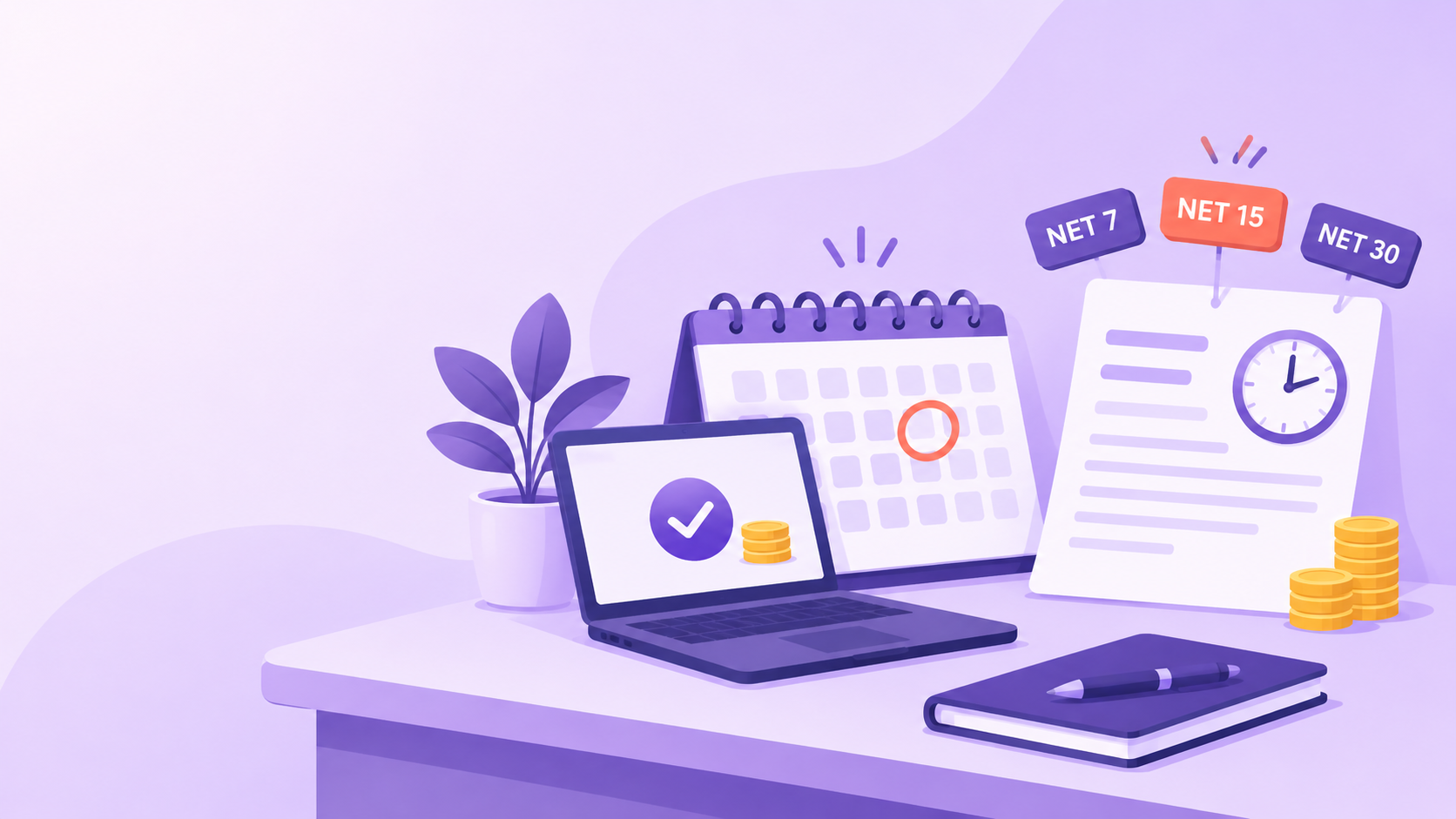
Most freelancers don’t have a client problem. They have a payment terms problem. You do great work, send the invoice, and then wait. And wait. Not because the client is shady, but because your invoice never told them exactly when to pay, or what happens if they don’t.
Payment terms are the rules that say when an invoice is due and what happens after that date. Set them well and you get paid faster with far fewer awkward follow-ups. Set them vaguely (or not at all) and you end up writing reminder emails to clients who honestly forgot.
This guide breaks down the most common payment terms, helps you pick the right one for each type of client, and shows you how to add late fees without damaging the relationship.
What Are Payment Terms?
Payment terms are the conditions on your invoice that define the due date, the accepted payment methods, and any penalty or discount tied to timing. A typical line looks like “Net 15” or “Due on receipt.” Together with your contract, they set the expectation before the money is ever at stake.
The Most Common Payment Terms Compared
| Term | What it means | Best for |
|---|---|---|
| Due on receipt | Payment is expected as soon as the client gets the invoice | Small projects, new clients, one-off work |
| Net 7 / Net 15 | Payment is due 7 or 15 days after the invoice date | Most freelancers and small agencies |
| Net 30 | Payment is due 30 days after the invoice date | Larger companies with accounts payable teams |
| Net 60 | Payment is due 60 days after the invoice date | Rarely worth it for a freelancer’s cash flow |
| Upfront / deposit | A portion (or all) is paid before work begins | New clients, fixed-price projects, high-value work |
Due on receipt
The fastest option, and the right choice for smaller projects or clients you haven’t worked with before. The catch is that “due on receipt” can feel abrupt, and some clients read it as a suggestion. Pair it with a clear date on the invoice so there’s no ambiguity.
Net 15
For most freelancers, this is the sweet spot. It gives the client enough time to process the invoice without letting your cash flow drift for a month. If you’re unsure where to start, start here.
Net 30
Net 30 is standard in many companies, and larger clients often insist on it because of how their accounts payable process works. It’s fine for steady, reliable clients, but it means you’re effectively lending them your money for a month. Plan your own bills around it.
Net 60 and beyond
Be cautious here. If a client asks for 60-day terms, consider offsetting the delay with a larger deposit, milestone payments, or a small increase in your rate.
How to Choose the Right Terms for Each Client
You don’t need one rule for everyone. A simple way to decide:
- New client, small project: due on receipt or Net 7, plus a deposit.
- New client, larger project: a 30% to 50% deposit, then milestone invoices on Net 15.
- Repeat client with a good payment history: Net 15, or Net 30 if their company requires it.
- Retainer client: invoice at the start of each month, due on receipt or Net 7, so you’re paid for the work you’re about to do rather than the work you’ve already done.
Use Deposits and Milestones to Protect Your Cash Flow
Payment terms work best when they are combined with a payment schedule. Instead of one big invoice at the end of a project, split the fee into stages: a deposit to start, a payment at a defined midpoint, and a final payment on delivery. Each invoice is smaller, easier to approve, and tied to something the client has already seen. It also means you never carry more than a small amount of unpaid work at any time.
How to Add Late Fees (Without Being the Bad Guy)
A late fee isn’t meant to punish anyone. It simply tells the client that the due date is real. In practice, most clients never pay one, because the clause is enough to move your invoice up their list.
Choose a fee you can defend
Many freelancers use a small percentage per month on the overdue balance, often somewhere between 1% and 2%, or a modest flat fee. Rules about how much you can charge, and whether you must state it in advance, vary by country and region. Check what applies where you and your client are based, and if the amounts are significant, ask a professional.
Add a grace period
A short grace period (3 to 7 days) keeps the tone fair and gives honest mistakes room to be fixed. It also makes you look reasonable if you ever do have to enforce the fee.
Agree to it in writing before the work starts
A late fee that appears for the first time on an overdue invoice is hard to collect. Put it in your contract or proposal, and repeat it on every invoice. The client should never be surprised by it.
Sample late fee wording
Payment is due within 15 days of the invoice date. Invoices unpaid after a 5-day grace period will incur a late fee of 1.5% per month on the outstanding balance. Work may be paused until overdue balances are settled.
Adjust the numbers to suit your situation and local rules. The structure (due date, grace period, fee, consequence) is what matters.
Where to Put Your Payment Terms
Don’t rely on a single place. The strongest approach is to repeat your terms at three points:
- In your proposal: so the client sees the payment schedule before they say yes.
- In your contract: so the terms and late fees are legally agreed, not just mentioned.
- On every invoice: with the exact due date written out, not just “Net 15.”
Common Payment Terms Mistakes
- Leaving the due date vague. “Pay soon” or “upon completion” means different things to different people. Use a calendar date.
- Offering Net 30 by default. Longer terms are a favor you can give to reliable clients, not a starting point for everyone.
- Making the invoice hard to pay. If clients have to hunt for bank details or request a payment link, you’ve added delay. Include a one-click payment option.
- Waiting too long to follow up. A polite reminder a few days before the due date, and another the day after, prevents most overdue invoices.
- Not enforcing your own terms. If you waive late fees every time, clients learn that the due date is optional.
Make Your Terms Automatic
The best payment terms are the ones you don’t have to remember. When your proposal, contract and invoice all carry the same terms, and reminders go out on schedule, you stop chasing and start getting paid. That’s the idea behind Kwill: keep proposals, contracts, e-signatures and payments in one flow, so the terms a client agrees to are the same terms that show up on the invoice.
Quick Checklist Before You Send Your Next Invoice
- Is the due date written as an actual date?
- Do the terms match what’s in your contract?
- Is the late fee (and grace period) stated?
- Can the client pay in one click?
- Have you scheduled a reminder before the due date?
Frequently Asked Questions
What is the best payment term for a freelancer?
Net 15 works well for most freelancers, combined with a deposit for new clients. Use due on receipt for small projects, and only offer Net 30 to clients who require it or have a reliable payment history.
Is it okay to charge a late fee?
Generally yes, as long as it is agreed in writing before the work begins and complies with the rules where you operate. Keep it reasonable and state it clearly.
What does Net 30 mean on an invoice?
It means the full payment is due 30 days after the invoice date.
Should I ask for a deposit?
For new clients and fixed-price projects, yes. A deposit confirms commitment and covers your early work.
Final Thoughts
Clear payment terms are one of the simplest ways to protect your income. Choose a due date that fits the client, split large projects into stages, state your late fee up front, and repeat everything in your proposal, contract and invoice. Do that, and late payments become the exception instead of the routine.
Leave a Reply